

I. Hitchhiking
What is hitchhiking ?
It is a way of transport which works by asking to people to take us in their car or other vehicule. It is asking for free. Travelers have been often using hitchhiking as a way of transport during a major part of the last century (between 1900 and 2000) and keep using it today.
Which way of transport can we use ?
All of them (more or less hard to take depending if it is a paying one on the basis)
-
Car/Truck/Van/Campervan/taxi
-
Bus/coach
-
Motorbike
-
Bicycle
-
Plane
-
Boat
-
Animals
a) Why did we choose this way of transport ?
-
The meetings with local people There is around 99% of chance that we won't meet the people who take us hitchhiking if we were using a way of transport called "personal" in which we would be alone with our family or not. If everyone is in its own car with different lifes, there is really a few chance for us to meet.
-
It is a pretty safe way of transport if we know how to listen ourselves. We can jump in the car of the person who is stopping or just say no and continue if we don't feel safe or even ask to go out of the car at anytime.
-
It is also a more sustainable transportation because we share a same vehicule which will pollute less than if we were using one for each person. We can say that we divide our carbon footprint by the number of people in the car.
b) What is the carbon footprint ?
When you use fossil fuels (-The main fossil fuels are oil, coal, gas.) Fossil fuels are due to a fossilization of dead matter, animal or plant.They are part of non-renewable energies because if their consumption is very fast, their formation by fossilization takes by against millions of years! -), like heating oil to keep your house warm or gasoline for your family's car, these things create carbon dioxide, also called CO2. Carbon dioxide is a greenhouse gas. Many scientists think that the greenhouse effect makes the earth too hot. Your carbon footprint is the total amount of CO2 you create. A large carbon footprint is bad for the planet.
- Calculation carbon footprint on our hitchhiking in comparison to the same journey with a personal car:
Average CO2 emission for a car over 1km = 205g of CO2
Number of kilometers that we will do hitchhiking = about 55 000 km
How many grams of CO2 would be emitted by a single person in a car?
205x55000 = 11,275 tons of CO2
How many grams would 3 people each have their cars?
11,275x3 = 33,825 tonnes of CO2
So we divide by three our rate of greenhouse gas emissions, we say that we divide our carbon footprint.
c) What is carpooling ?
Hitchhiking is the unplanned and free version of carpooling. There are now websites to connect people who will go from one place to another by car and people who want to do the same or part of the same journey. The person who takes the others receives a payment from the people who ride with him, it's like a taxi but a lot cheaper and the people who do this are often people who do it to not be alone on their way and that they can meet other people. While the taxi works for him and he makes the trip only for the customer, so it's like a personal car from an ecological point of view.
However, you can preserve nature a little by practicing carpool with your family or friends too, by riding more in a car and thus using fewer cars when we all go to the same place. even more fun!
To practice hitchhiking, it is best to be accompanied by an adult or to wait until you are 18 years old. And your parents, or you when you have a car, can take hitchhikers, we make sure that you have a great chance to make a great meeting and you will have helped someone to advance while staying on your own path .
d) What do you need to know before practicing hitchhiking ?
Do not be in a hurry, be patient, keep your smile, know how to accept the refusal, always keep in mind that you are asking for a service to someone and that the people we ask for do not have anything to do base, love meetings, recognize a strategic place or the opposite, remember that the interest of a trip by hitchhiking is the entire journey and not the point of fall.
II. The nomadism
a) What is the nomadism?
-
A way of living based on displacement.
-
The quest for food motivates the movement of men: the fact of living from gathering and hunting may be at the origin, but the largest nomadic societies practice pastoral breeding, where the search for pastures (raising animals in enclosures covered with grass for the animals to eat)
-
When there is no food for the animals, the men have to move to find a new place to live where their animals can eat.
b) In History :
200,000 to 300,000 years ago, in prehistoric times, the Cro-Magnon man lived by hunting and gathering. Nomadic people live differently from our culture, they are constantly outside and live with nature. They get up at the same time as the sun and go to bed at the same time as they do, their activities also depend on the weather. If it is a very big storm they will not be able to go to do a lot of things whereas in the sedentary culture (= contrary of nomad), one has a house and a roof if it rains to protect itself, the nomads must live with the hazards of nature and learn to predict them.
There are few totally nomadic peoples in the world because they often end up being evicted from places where they set up their camp because the space belongs to a society or just a village.
When nomadic people move with their animals from one place to the next they call it transhumance.
Exemple of nomadism:
III. Mongolia
The country between Russia and China whose capital is Ulaanbaatar is as big as 2.5 times France and yet there are only 2 inhabitants per square kilometer. It is one of the countries with the lowest population density in the world.
In Mongolia, there are 3 million people in total and almost 1 million are still nomads.
The landscapes are usually steppes, snowy montages, extinct volcanoes, small towns or the Gobi Desert.
Volcano in Mongolia City in Mongolia
Mongolian steppes
Snowy mountains
Gobi desert in summer
IV. Myanmar
Burma lies between Thailand and Bangladesh in Southeast Asia and also has a second name, Myanmar.
It is a country with multiple landscapes with a center of mountainous land and full of vegetation but also with beautiful beaches paradise. There are also many Buddhist temples as on the plain of Bagan where there are more than 2000 temples.
When are they going to school ?
There are three types of schools: public, private and religious, mainly Buddhist. The state provides officially free and compulsory education for children from 5 to 9 years old. To be able to continue they must pass an exam on everything they have learned and continue the school for 4 years and if they succeed again, they can still continue 2 years. So they can go to university at 15 if they are successful.
The school year starts in June and ends in March.
What is the main religion in Myanmar ?
In Burma the majority of the population is Buddhist and there are many monks (several hundred thousand) in monasteries and temples removed, as in small villages. There are also less Buddhists of all ages, and especially who become so while they are still children. Only boys can be monks, girls can be nuns but they are considered inferior to monks and must obey them.
How to become a munk?
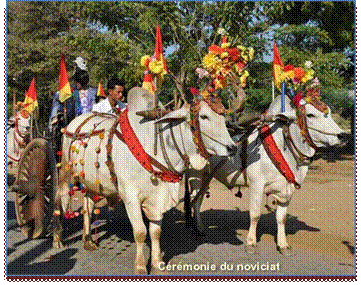
Between 5 and 15 years old, the little boy enters the monastery as "samanera" (a new one), it is a very important event for him and his family. The parents celebrate the event extravagantly: the little boy is dressed in prince's clothes, made up, wears jewels, he wears lotus flowers on his head. He is then mounted on a horse or in a car or in an ox-drawn car.
In front, parents and relatives wear the only eight essentials for the novice. Not all families can afford such a big ceremony, some are smaller.